
|
Bandages & Bloodshed
America At War
|
|
Colonial Medicine
|
|
Revolutionary War
|
|
Field doctors were known to suck on infected wounds to clean
|
|
Civil War
|
|
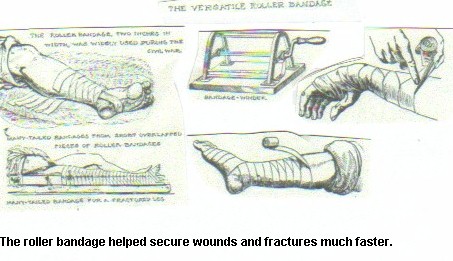
The invention of the roller bandage helped treat wounds and fractures more
easily and quickly. ( Click on photo at right to see the bandage and its uses.) |
|
and the
|
|
Simple wounds were cleaned with soap and water before they were covered with tree sap to
secure strips of linen to the wound. Simple wounds were also covered with a plaster made from flannel that was dipped in canthard (crushed green blister beetle) or with a poultice made from a hot milk and bread mixture dipped in oil or lard. |
|
Infections were burned from wounds with the flame from a candle.
|
|
WWII
|
|
During the Civil War, more than 50% admitted to hospitals with wounds died.
That number fell to 8% in WWI and to 4% in WWII. |
|
Dried blood was sprinkled on wounds to encourage clotting. Glues were used to
seal wounds |
|
Penicillin and other antibiotics were used to treat wound infections. Click
on medical bag (right) to hear about WWII medics. |
|
In 1941, many physicians used human fibrinogen and cattle thrombin to stop
blood loss and glue skin grafts |

|
Florence Nightingale learned that more battlefield wounded survived if a
doctor cleaned his instruments in hot water between surgical procedures. |
