
The present technology associated with diabetes deals with monitoring blood sugar levels. The traditional test involves several steps as observed in the video (see Homepage):
Pricking the side of a finger (painful!);
The blood is placed into a test strip;
The test strip is inserted in the glucometer;
Depending on the result the patient may get an injection with a dose of insulin to lower his/her blood sugar or may have to eat something to increase his/her blood sugar;
In some cases the test has to be repeated because not enough blood was drawn from the finger.
These steps have to be repeated 6 to 7 times per day.
Glucose meter technology has been improving, some recent devices include the sensor that is implanted under the skin for continuous monitoring and the GlucoWatch.
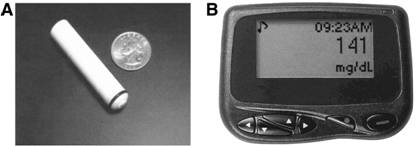
The sensor, (size of a AA battery), is implanted under the skin of the abdomen and measures glucose levels every 30 seconds, data is transferred every five minutes to a receiver the size of a cell phone providing better chances of maintain a normal glucose range by administering insulin when needed. (Figure, A: Implantable glucose sensor the size of a AA battery. B: The receiver—a pager-like device).
http://care.diabetesjournals.org/cgi/content/full/27/3/734
The GlucoWatch has a sensor i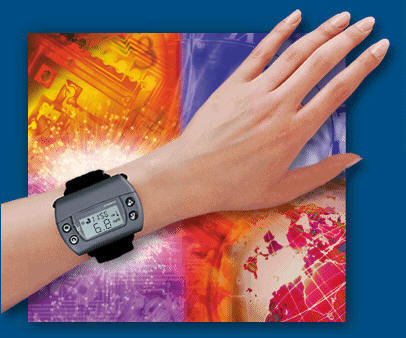 n the back that adheres to the
skin. A low electric current pulls glucose through the skin and
allow diabetics to monitor glucose levels non-invasively (though
calibration of the device requires the invasive finger pricking method
at least twice per day). The GlucoWatch automatically monitors glucose
levels every 10 minutes for up to 13 hours at a time. The GlucoWatch
supplements, but not replaces, conventional blood glucose monitoring
n the back that adheres to the
skin. A low electric current pulls glucose through the skin and
allow diabetics to monitor glucose levels non-invasively (though
calibration of the device requires the invasive finger pricking method
at least twice per day). The GlucoWatch automatically monitors glucose
levels every 10 minutes for up to 13 hours at a time. The GlucoWatch
supplements, but not replaces, conventional blood glucose monitoring
http://www.glucowatch.com/us/default.html
In conclusion, the technology that currently deals with diabetes consists on attacking an existing problem. Our team decided to develop the D.A.P.e.S. to help kids control and, more importantly, to prevent diabetes. We will explain what we learned and how feasible and important our D.A.P.e.S. is.