






Present Technology
Dialysis
 Dialysis is a type of renal replacement
therapy which is used for patients who have lost their kidney function. This
procedure acts as an artificial replacement for a lost or damaged kidney. It
uses diffusion of solutes along a concentration gradient across a semi-permeable
membrane while a sterile solution made of water, sugars, and other components
are on the other side of the membrane. As the blood flows, the red and white
cells (as well as other important blood components) remain on the "blood" side
of the membrane; the smaller urea and salt components, however, are able to flow
through into the sterile solution and be removed from the body.
Dialysis is a type of renal replacement
therapy which is used for patients who have lost their kidney function. This
procedure acts as an artificial replacement for a lost or damaged kidney. It
uses diffusion of solutes along a concentration gradient across a semi-permeable
membrane while a sterile solution made of water, sugars, and other components
are on the other side of the membrane. As the blood flows, the red and white
cells (as well as other important blood components) remain on the "blood" side
of the membrane; the smaller urea and salt components, however, are able to flow
through into the sterile solution and be removed from the body.
http://alfin2100.blogspot.com
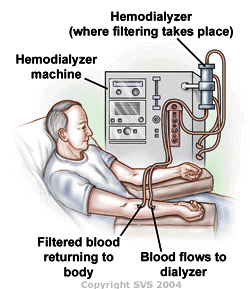
Hemodialysis
This procedure is performed at least three times a week. A patient is linked intravenously to a machine which redirects blood out of the body and into a semi-permeable membrane. Once the machine is finished filtering the blood, the cleaned blood components are injected back into the blood stream.
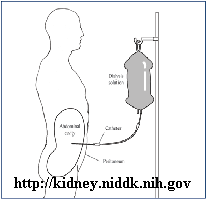
Peritoneal Dialysis
This method works by using the lining of the abdomen (known as the peritoneum) as a natural membrane for filtering waste. A catheter is first inserted into the abdominal cavity which allows for the injection of a dialysis fluid (a glucose solution containing other salts). The wastes in the blood are diffused and filtered through the membrane and dissolved into the fluid to undergo a process known as ultrafiltration. Ultrafiltration is a procedure that involves glucose "sucking" the excess water across the membranes and out of the body. The wastes in the blood are then captured in the solution, which is then repeatedly drained and replaced several times a day.
Bioartificial Kidney
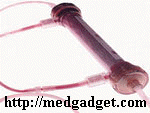 The bioartificial kidney "includes a
cartridge that filters the blood as in traditional kidney dialysis. That
cartridge is connected to a renal tubule assist device, which is made of hollow
fibers lined with a type of kidney cell called renal proximal tubule cells.
These cells are intended to reclaim vital electrolytes, salt, glucose, and
water, as well as control production of immune system molecules called
cytokines, which the body needs to fight infection." Currently, this
technology is being tested by researchers who hope that the device can become
implantable in patients with chronic renal failure as a long-term replacement
for kidney function.
The bioartificial kidney "includes a
cartridge that filters the blood as in traditional kidney dialysis. That
cartridge is connected to a renal tubule assist device, which is made of hollow
fibers lined with a type of kidney cell called renal proximal tubule cells.
These cells are intended to reclaim vital electrolytes, salt, glucose, and
water, as well as control production of immune system molecules called
cytokines, which the body needs to fight infection." Currently, this
technology is being tested by researchers who hope that the device can become
implantable in patients with chronic renal failure as a long-term replacement
for kidney function.
Nano-Pore Membranes
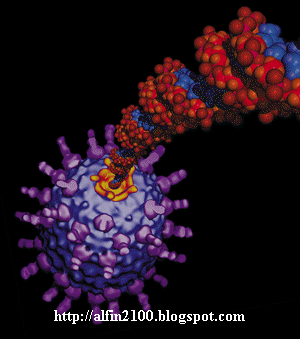 Research is currently
ongoing that may allow dialysis to be miniaturized into implantable devices.
This would enable round-the-clock clearance of toxins, thereby releasing dialysis patients from
bulky pumps and repetitive clinic visits. William Fissel, a Mephrologist at the
University of Michigan, and his colleague Shivo Roy, a biomedical engineer at
the Cleveland Clinic Foundation, claim to have solved half the challenge. The
challenge consists of engineering nano-membranes that are efficient enough to
support a compact, low-power implant, but they are still researching this idea
and feel that it will be the next step to help replace the dialysis procedure.
Research is currently
ongoing that may allow dialysis to be miniaturized into implantable devices.
This would enable round-the-clock clearance of toxins, thereby releasing dialysis patients from
bulky pumps and repetitive clinic visits. William Fissel, a Mephrologist at the
University of Michigan, and his colleague Shivo Roy, a biomedical engineer at
the Cleveland Clinic Foundation, claim to have solved half the challenge. The
challenge consists of engineering nano-membranes that are efficient enough to
support a compact, low-power implant, but they are still researching this idea
and feel that it will be the next step to help replace the dialysis procedure.